The Circumference Formula Explained: Where C = 2πr Actually Comes From
A clear, illustrated explanation of the circumference formula, the role of π, three common variations, and how to use the formula in real-world problems.
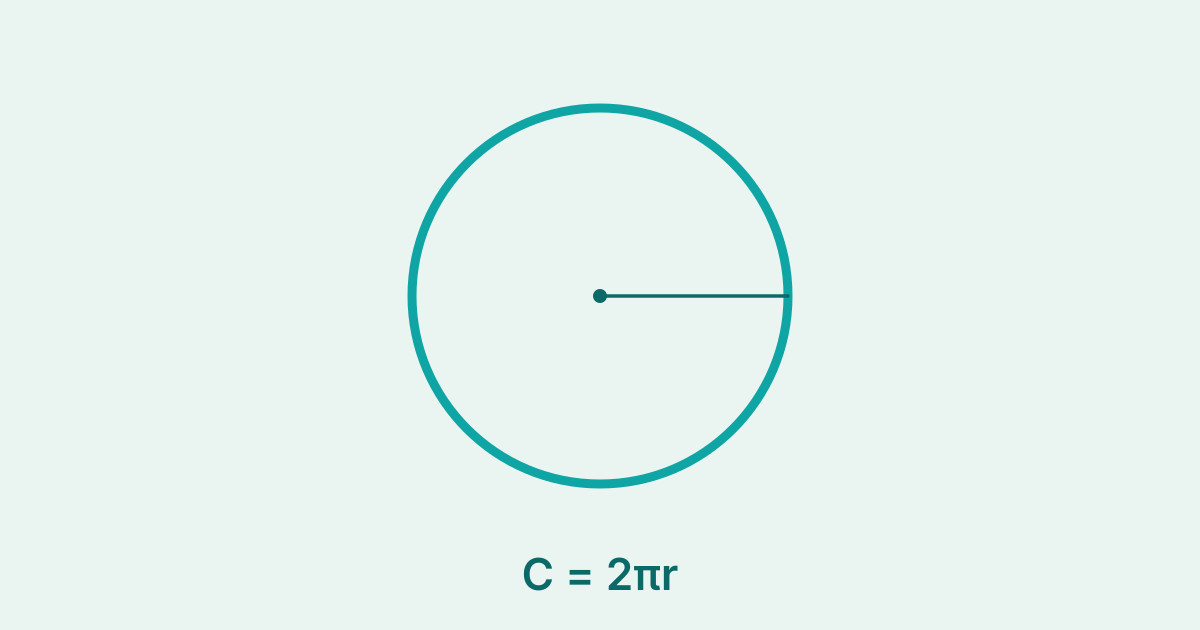
Most people who pick up a calculator and type 2 * pi * r couldn’t tell you, off the top of their head, why that particular formula gives you the distance around a circle. We learn it in school, memorise it for an exam, and move on. But the circumference formula has one of the cleanest, most satisfying derivations in all of mathematics — and once you see it, you’ll never look at a circle the same way again.
This article walks through three things: what the formula actually says, where it comes from, and how to use it in the kinds of practical problems you actually meet in life. If you just need to crunch a number, our circumference calculator does the arithmetic for you. If you want to understand what’s happening, read on.
What the formula says
There are two equivalent ways to write the circumference formula:
C = 2πr when you know the radius
C = πd when you know the diameter
Both are saying the same thing. The diameter is just twice the radius (d = 2r), so substituting one into the other gets you back to the same statement. Pick whichever version matches the value you already have.
In words: the distance once around a circle is always π times the diameter. That ratio — between the way around a circle and the way across it — is fixed. It doesn’t matter whether the circle is the size of a coin or the size of the Moon. The ratio is the same. We call that ratio π (pi).
A quick sanity check
Imagine a circle with a radius of 1. Plug it in: C = 2 × π × 1 = 2π ≈ 6.283. So a circle one unit across the radius is about 6.28 units around. Now double the radius. C = 2 × π × 2 = 4π ≈ 12.566. Doubling the radius doubled the circumference — exactly as you’d expect from a formula linear in r.
What π actually is
π is what mathematicians call an irrational number: its decimal expansion goes on forever without repeating. The first digits are 3.14159265358979… but for almost every real-world calculation, the first five or six are plenty. JavaScript’s built-in Math.PI, which we use on this site, is accurate to about 15 significant digits — more precision than any physical measurement you’re likely to make.
Where the formula actually comes from
Here’s the part most textbooks skip. The reason C = πd isn’t a coincidence; it’s almost a definition. Specifically:
π is, by definition, the ratio of any circle’s circumference to its diameter.
Read that again. π isn’t a magical constant that just happens to show up in circle formulas. It’s the name we give to that ratio. So the statement “C = πd” is really saying “the circumference equals (circumference divided by diameter) times the diameter” — which is true by simple cancellation.
So why is the ratio the same for every circle? That’s the surprising part, and it comes down to similarity. All circles are similar shapes — you can scale any circle up or down to perfectly match any other. When you scale a shape, every length scales by the same factor. So if you double the diameter of a circle, the circumference also doubles. The ratio between them — circumference over diameter — never changes. That fixed ratio is π.
How do we know π ≈ 3.14159?
Archimedes, around 250 BCE, came up with the most beautiful method. Take a regular polygon (say a hexagon) and inscribe it inside a circle. Now circumscribe another hexagon outside the same circle. The circle’s circumference is squeezed between the two perimeters: it must be bigger than the inside hexagon and smaller than the outside one. Now double the number of sides — 12-gon, 24-gon, 48-gon, 96-gon — and the polygon perimeters squeeze tighter and tighter. By the time you reach a 96-sided polygon, you can pin π between 3 + 10/71 and 3 + 1/7 — accurate to two decimal places.
Modern algorithms based on calculus and series expansions can compute trillions of digits, but Archimedes’ geometric squeeze remains the most intuitive proof that the ratio is well-defined.
Three useful rearrangements
You’ll often have a circle’s circumference or area and need the other values. From the basic formula, you can derive:
| You know | You want | Formula |
|---|---|---|
| Radius (r) | Circumference (C) | C = 2πr |
| Diameter (d) | Circumference (C) | C = πd |
| Circumference (C) | Radius (r) | r = C / (2π) |
| Circumference (C) | Diameter (d) | d = C / π |
| Area (A) | Radius (r) | r = √(A / π) |
| Area (A) | Circumference (C) | C = 2π × √(A / π) = 2√(πA) |
The last row is genuinely useful and not as well-known as it should be: C = 2√(πA). Memorise it if you do a lot of work that starts from area.
Using the formula: three real problems
Now let’s put it to work. The point of any formula is to solve actual problems, so here are three that show off different uses.
Problem 1 — Sizing a circular skylight
Suppose you’re installing a circular skylight with a diameter of 1.2 m. You need a rubber seal that goes around the rim. What length do you order?
Use C = πd directly:
C = π × 1.2 ≈ 3.14159 × 1.2 ≈ 3.770 m
Order 4 metres to allow for trimming and a small overlap. Done.
Problem 2 — How fast is the tip of a fan blade moving?
A ceiling fan has blades that reach 0.6 m from the centre and spin at 120 revolutions per minute. How fast is the very tip of the blade moving through the air?
First, find the distance the tip travels in one revolution — that’s the circumference at radius 0.6 m:
C = 2π × 0.6 ≈ 3.77 m per revolution
Now multiply by revolutions per minute:
3.77 × 120 = 452 m/min ≈ 7.5 m/s
That’s about 27 km/h — fast enough that you can feel the breeze and slow enough that the blade still looks like a blur, not a discrete object. Most ceiling fans are designed in exactly this range.
Problem 3 — A puzzle about Earth and rope
Here’s a classic. Imagine a rope tied tightly around the Earth at the equator (radius ≈ 6,378 km). Now imagine adding just 1 metre to the total length and lifting the rope evenly off the ground all the way around. How much of a gap appears between the rope and the surface?
Most people guess “millimetres”. The actual answer is surprising.
The original circumference is C = 2π × 6,378,000 m. The new circumference is C + 1 m. The new radius is (C + 1) / (2π). The gap is:
Gap = new radius − old radius = (C + 1) / (2π) − C / (2π) = 1 / (2π) ≈ 0.159 m
About 16 centimetres — enough to slide a fist underneath, all the way around the planet. The size of the original circle is completely irrelevant: adding 1 metre to any circle’s circumference, no matter how big, lifts the boundary by exactly 1/(2π) ≈ 16 cm. That’s the kind of result you only get from understanding the formula, not just plugging numbers into it.
Frequently asked questions
Q: Why is π in the area formula too? A: Because area is, loosely, “the integral of the circumference”. Imagine slicing a circle into many concentric rings — each ring has length 2πr and thickness dr. Summing them up gives πr², so π naturally appears in both formulas.
Q: Is the formula different for an ellipse? A: Yes, and it’s much harder. The perimeter of an ellipse has no neat closed-form formula; you need an elliptic integral or an approximation (Ramanujan’s is excellent).
Q: What if I’m working in radians or degrees? A: The formulas are unitless — they don’t care about angle units. r, d, and C just need to be lengths in the same unit.
Q: Why does the calculator round to 2, 4, or 6 decimal places? A: Because most real-world measurements have at most a few significant figures. Six digits is overkill for almost everything but engineering and physics.
That’s the circumference formula in full: what it says, where it comes from, and how to use it. Bookmark our calculator for next time you need a quick answer, and check our About page if you’d like to know who’s behind the writing.
Related posts
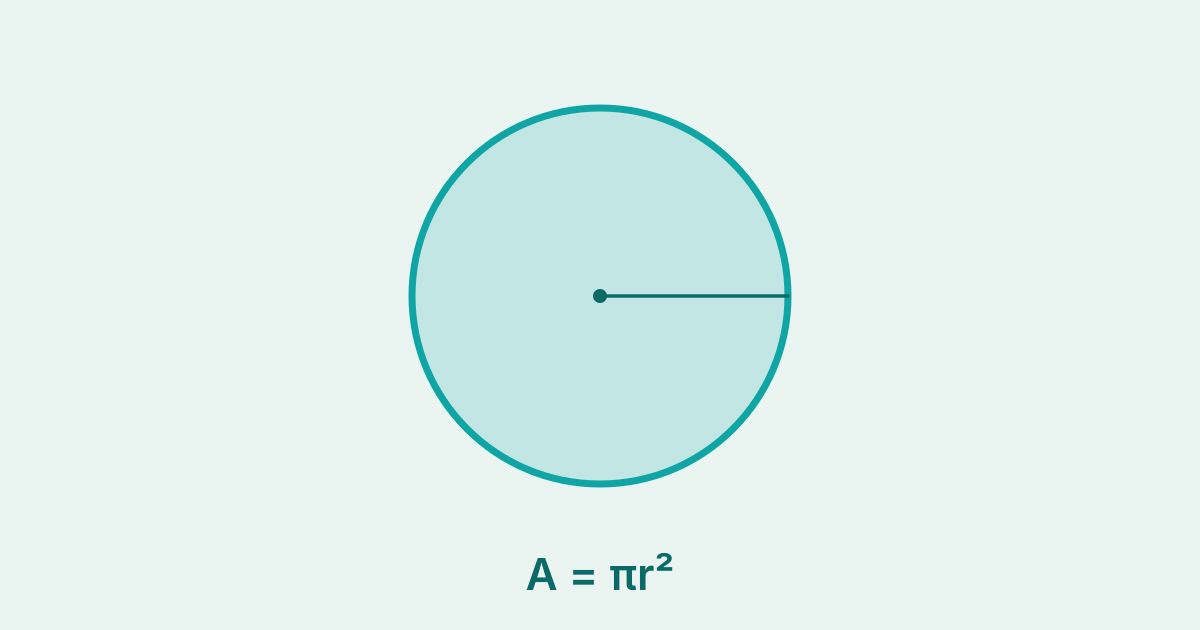
How to Find the Area of a Circle (Formula + Examples)
How to find the area of a circle using A = πr². Simple steps and worked examples for finding the area from the radius, diameter, or circumference — plus a free calculator.
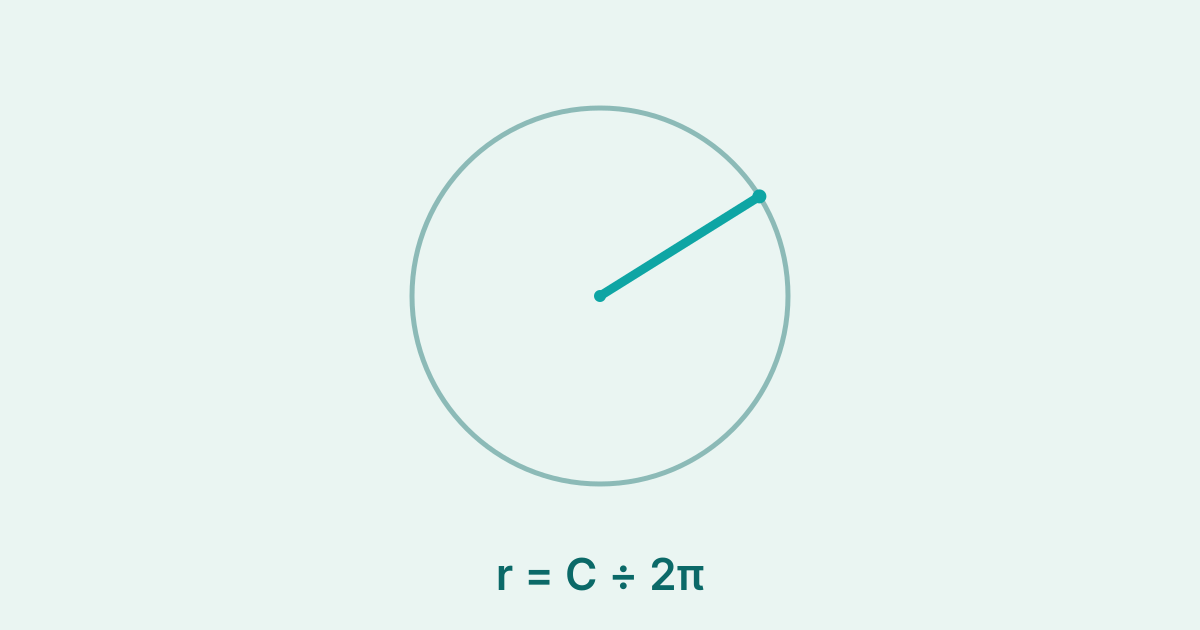
How to Find the Radius From the Circumference (With Examples)
How to find the radius from the circumference using r = C ÷ (2π). Simple steps and worked examples, plus a free calculator that does it instantly.
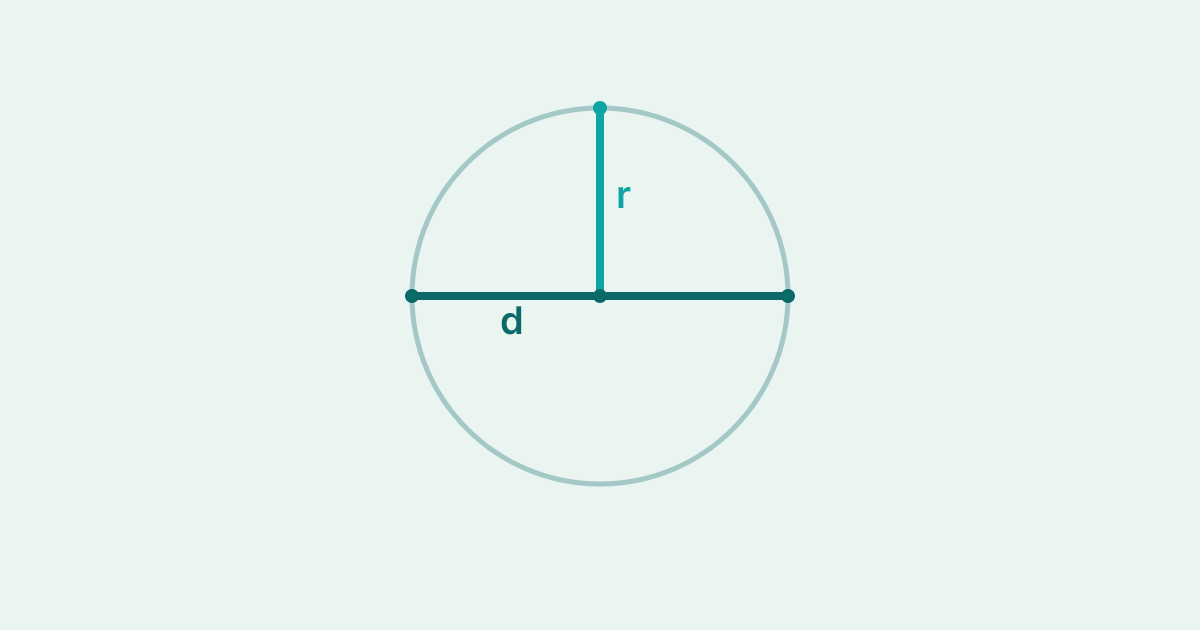
Radius vs Diameter: What's the Difference?
The difference between the radius and diameter of a circle, how to convert between them, and simple examples. Plus a free calculator for radius, diameter, circumference, and area.